

The Hidden Patterns Behind $2.25 Trillion in Construction Disputes—And What You Can Do About It
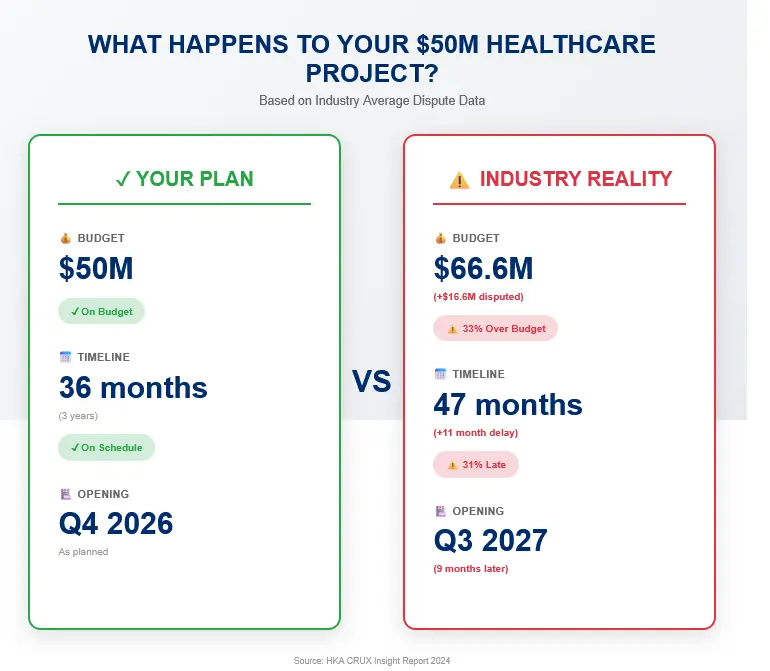
The CFO was confident: $50M budget, 3-year timeline, opening in Q3 2024. The reality? $66.6M spent, opening delayed to Q2 2025, and nine months of explaining to the board what went wrong. This scenario isn’t a worst-case example—it’s the industry average based on analysis of over 2,000 construction projects worldwide.
HKA’s seventh annual CRUX Insight Report, “Changing the Narrative,” analyzed projects across 107 countries with a combined value of $2.254 trillion—and the findings have critical implications for healthcare organizations planning major capital projects. Here’s why this happens to so many projects, and more importantly, what you can do to make sure it doesn’t happen to yours.
Is Your Project at Risk? Quick Self-Assessment
Before we dive into the research, take 60 seconds to assess your project’s risk level:
Answer these 5 questions:
□ Design maturity: Is your design less than 90% complete before construction starts?
□ Procurement approach: Are you selecting contractors primarily on the lowest price?
□ Financial planning: Do you have less than 15% contingency built into your budget?
□ Schedule pressure: Is your project timeline driven by external deadlines (funding, political pressure, market timing) rather than realistic planning?
□ Due diligence: Have you skipped or shortened comprehensive site assessments (environmental, geotechnical, utilities) to save time or money?
Your Risk Level:
0-1 boxes checked: Low risk – You’re following best practices
2-3 boxes checked: Moderate risk – Address these issues before they become problems
4-5 boxes checked: High risk – Your project faces a significant probability of disputes and delays
If you checked two or more boxes, the research findings below are significant for your project.
The State of Construction Disputes
According to the CRUX report, disputed construction projects experience average cost overruns of $83.1 million and time delays of 16 months. While not every project ends up in dispute, the industry-wide data shows average added costs of 33.2% of project budgets and schedule extensions of 66.5% – meaning a $50M healthcare project could face approximately $16.6M in additional costs and schedule delays of 9-11 months even without formal disputes. For healthcare organizations operating on tight margins and planning around specific opening dates for new facilities, these overruns can have cascading effects on operations, financing, and patient care delivery.
While this data spans all construction sectors—buildings, infrastructure, energy, manufacturing, and technology—the patterns are particularly relevant for healthcare organizations. When you’re investing millions in critical infrastructure like hospital expansions or outpatient facilities, these disputes represent more than financial setbacks. They delay patient care capacity, disrupt clinical operations, and can compromise the quality of healing environments your community depends on.
The Top 10 Causes of Claims and Disputes Across All Construction
According to the global data, these are the leading causes affecting construction projects:
- Change in scope (36.9% of projects)
- Incorrect design (21.5%)
- Late design information (21.3%)
- Incomplete design (19.8%)
- Contract management/administration failure (18.0%)
- Poor management of subcontractors/suppliers (17.9%)
- Contract interpretation issues (17.8%)
- Workmanship deficiencies (17.7%)
- Restricted or late site access (16.8%)
- Unforeseen physical conditions (16.6%)
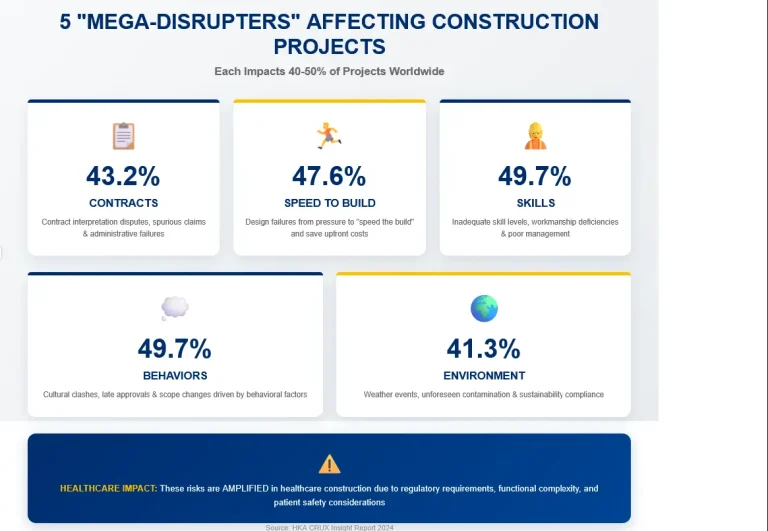
Five "Mega-Disrupters" Affecting 40-50% of Projects
The report introduces a framework identifying five critical factors that each affect nearly half of all construction projects worldwide:
1. Contractual Conflicts (43.2% of projects globally)
Contract interpretation disputes, spurious claims, tender errors, and administrative failures plague projects across all sectors.
Real-World Example: A hospital expansion project specified “industry-standard infection control barriers” during construction. Two months in, disputes erupted over what “industry-standard” meant. Temporary walls, negative pressure systems, and HEPA filtration all had different cost implications. The contractor’s interpretation was basic plastic barriers ($50K). The hospital’s expectation, based on ICRA requirements, was full containment with negative pressure ($150K)—resulting in a 3-month delay and litigation over a vague contract term.
What You Can Do: Invest time upfront in war-gaming potential contract disputes before signing. Conduct facilitated challenge sessions with all parties—including major subcontractors—to identify contractual gaps and ambiguities. Ensure your project team has adequate authority and transparent approval processes to avoid administrative delays. Consider balanced risk allocation rather than excessive risk transfer to contractors, and specify dispute resolution mechanisms (like early neutral evaluation or dispute review boards) in your contracts from the start. For healthcare projects with complex stakeholder arrangements, establish clear decision-making protocols and approval timelines that all parties understand before construction begins.
2. Speed to Build (47.6% of projects affected)
Nearly half of all construction projects suffer from design-related failures driven by the pressure to “speed the build” and save upfront costs.
Real-World Example: A surgical suite renovation started construction with 85% complete drawings to “save time.” During rough-in, surgeons requested upgraded imaging integration, which required different ceiling heights, structural modifications, and mechanical system changes. The architect had to redesign while contractors waited. Original 12-month timeline stretched to 16 months. The $300K saved on design development became $500K in change orders and carrying costs. As one project executive put it: “We tried to save two months and lost four.”
What You Can Do: Resist the temptation to start construction before designs are truly mature. Allocate adequate time and budget for comprehensive design development—including coordination with infection control, clinical operations, IT, and biomedical engineering teams early in the process. Conduct thorough constructability reviews before issuing construction documents. Issue drawings only when they’re genuinely ready, not when the schedule demands it. Remember the industry mantra: “Go slow to go fast”—investing in mature design upfront prevents expensive mid-construction redesigns and changes. For healthcare projects requiring FGI Guidelines and Joint Commission compliance, build in time for proper regulatory review and approval cycles during design, not during construction.
3. Skills Shortages (49.7% of projects affected)
Inadequate skill levels, workmanship deficiencies, and poor subcontractor management affect construction projects globally.
Real-World Example: A medical office building hired a mechanical contractor based on a low bid. During the installation of the medical gas system, inspectors discovered that the crew lacked the required certifications for healthcare gas piping. The work had to be redone by certified technicians. Additional discovery: the electrical subcontractor had never worked with imaging equipment grounding requirements. The “savings” from low-bid selection: $180K. The cost to fix deficient work: $300K plus 3-month delay.
What You Can Do: Evaluate contractors and subcontractors not just on price, but on their demonstrated experience with similar healthcare facility types and complex building systems. Require proof of specialized training for critical trades working on medical gas systems, imaging shielding, and sterile processing areas. Consider specifying key personnel requirements in contracts and limiting substitutions. Implement robust quality control processes with independent inspections at critical milestones. For renovations in operating facilities, ensure contractors have demonstrated experience managing infection control protocols and phased construction. Budget for resident project representation or clerk-of-the-works positions to provide daily oversight—this investment typically pays for itself many times over in prevented rework and defects
4. Behavioral Issues (49.7% of projects affected)
Cultural clashes, late approvals, and scope changes driven by behavioral factors affect nearly half of all construction projects.
Real-World Example: During the mechanical room coordination phase on a hospital expansion project, MEP subcontractors stopped attending coordination meetings after disputes over responsibility for system conflicts. The general contractor, architect, and subs retreated to contractual positions rather than collaborating to resolve clashes, resulting in a 6-week delay while formal RFIs cycled through the chain of command – issues that could have been resolved in days through joint problem-solving sessions. This breakdown in trust and communication added costs for extended site supervision, schedule compression of downstream trades, and legal reviews of responsibility.
What You Can Do:
Establish a collaborative culture from day one by implementing Integrated Project Delivery (IPD) principles or alliance contracting models that align incentives across all parties. Structure regular coordination meetings with all key stakeholders – owner, architect, engineers, contractors, and major subcontractors – starting in pre-construction and continuing throughout the project. Create clear communication protocols that encourage early identification of issues without fear of blame or immediate contractual consequences.
Consider using co-location strategies where team members work together in a shared project workspace, breaking down silos and fostering real-time problem-solving. Implement collaborative technology platforms like cloud-based BIM coordination tools that provide transparency and shared accountability. Most importantly, select team members not just on price and technical capability, but on their demonstrated willingness to work collaboratively – and make partnership behaviors explicit expectations in your contracts and pre-construction agreements.
5. Environmental Factors (41.3% of projects affected)
Extreme weather events, unforeseen contamination, and sustainability requirements increasingly impact construction projects.
Real-World Example: Site excavation for a new patient tower uncovered underground storage tanks not shown on any historical records. Work stopped immediately for environmental assessment. Testing revealed petroleum contamination requiring remediation. Original site work budget: $1.2M over 4 months. Actual cost with remediation: $ 1.8M over 8 months. The pre-construction environmental assessment budget was cut to “save money”: $ 45K—the cost of that decision: $ 600 K plus a 4-month delay.
What You Can Do: Conduct comprehensive Phase I and Phase II environmental site assessments before design begins, and budget adequately for remediation if contamination is discovered. Don’t skip or shortcut these investigations to save upfront costs. Review force majeure clauses in contracts to ensure they appropriately address extreme weather events and establish clear protocols for how weather delays will be documented and managed. Build realistic schedule contingencies that account for your region’s weather patterns. Explicitly address sustainability and environmental compliance requirements in project scope and contracts from the beginning, as retrofitting these requirements mid-project creates disputes over responsibility and costs.
Why These Construction Industry Patterns Matter Even More for Healthcare
While the CRUX report covers all construction sectors, healthcare projects face additional complexity that amplifies these risk factors:
Regulatory Compliance is Non-Negotiable
Unlike commercial buildings, where some flexibility exists, healthcare facilities must meet stringent, non-negotiable codes and standards. The industry-wide problem of incomplete designs becomes critical when compliance requirements that should have been addressed during design development are missing.
Functional Complexity Demands Precision
Healthcare facilities rank among the most complex building types in the construction industry. The general construction problem of design errors doesn’t just cause cost overruns in healthcare—it can render spaces functionally unusable for clinical care.
Operating Facilities Add Layers of Risk
Most healthcare construction occurs in or adjacent to operating facilities. This adds infection control barriers, utility coordination, and vibration restrictions to the typical construction challenges documented in the CRUX report.
Patient Safety Raises the Stakes
While construction delays are costly in any sector, healthcare delays directly impact patient care. The industry-average 16-month time overrun isn’t just a schedule problem—it means continued ED overcrowding, deferred surgical procedures, and delayed community access to needed healthcare services.
The Healthcare-Specific Imperative
The construction industry data is clear: most disputes are predictable and preventable. For healthcare organizations, the stakes are even higher. Every day a project is delayed is another day your community goes without needed healthcare services. Every dollar wasted on avoidable disputes is a dollar diverted from patient care, equipment, or staff.
Healthcare leaders have a fiduciary responsibility to maximize the value of every capital dollar. The research shows that pushing ahead before you’re ready doesn’t save time or money in any construction sector—and in healthcare, it also compromises your institution’s mission to serve your community. (See post: 8 tips to keep your healthcare construction cost on track)
What This Means for Your Healthcare Project
Let’s make this research concrete. If you’re planning a $50 million healthcare construction project, this industry data suggests you should realistically prepare for:
- Potential disputed costs of $16.6 million (33.2% of budget)
- Schedule delays of nearly 11 months (66.5% extension)
- A three-year project timeline stretching to nearly four years
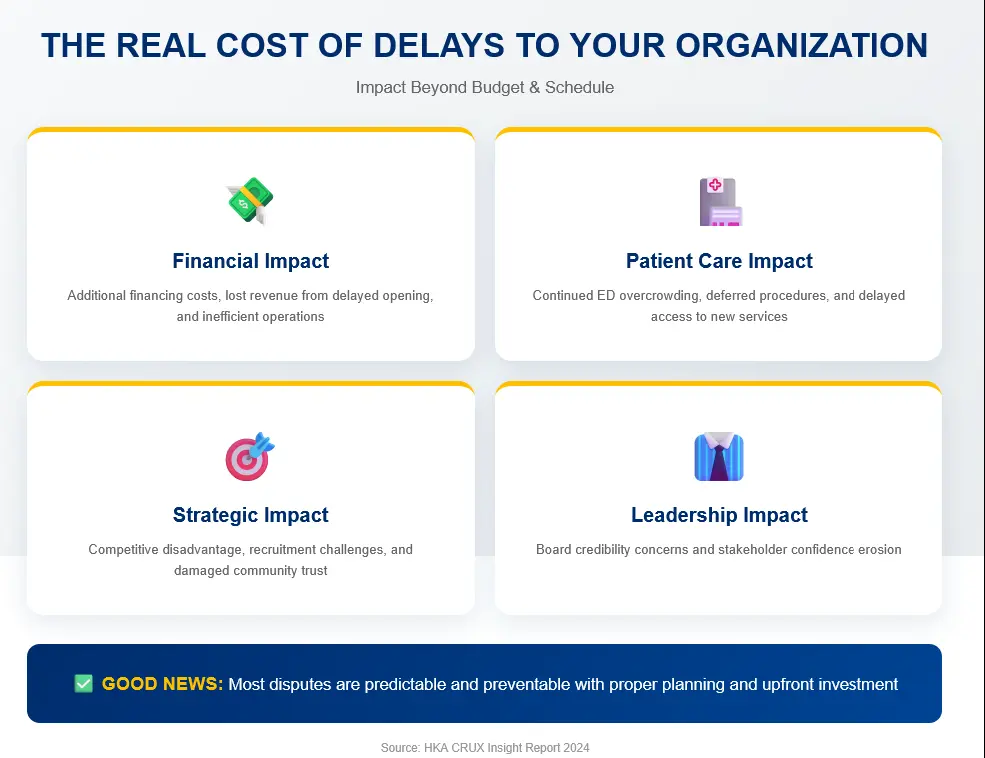
These aren’t worst-case scenarios—they’re industry averages across thousands of projects worldwide. For your organization, this means:
Financial Impact:
- Construction cost overruns requiring additional financing or budget reallocation
- Lost revenue from delayed facility openings
- Continued operation of inefficient existing facilities
- Opportunity cost of capital tied up longer than planned
- Potential bond rating implications from project performance issues
Operational Impact:
- Delayed surgical suite opening means continued case scheduling constraints
- Emergency department expansion postponement extends overcrowding and wait times
- New patient tower delay affects capacity planning and service line growth
- Extended construction duration increases disruption to adjacent operating areas
Strategic Impact:
- Competitive disadvantage if market competitors open new facilities first
- Physician recruitment and retention challenges without promised new facilities
- Community perception issues from repeatedly delayed project milestones
- Board and executive leadership credibility concerns
The Good News: Understanding these risks upfront allows you to:
- Build realistic contingencies into initial budgets and schedules
- Invest adequately in planning and design to prevent downstream disputes
- Select delivery methods and contract structures that minimize dispute potential
- Establish governance processes that catch and resolve issues early
- Set realistic stakeholder expectations from project inception
The choice is clear: invest in prevention upfront, or pay for disputes and delays throughout construction and beyond.
The Key Takeaways:
- Industry research shows disputed costs average 33.2% of construction project budgets
- Time overruns extend schedules by 66.5% on average across all construction sectors
- Five “mega-disrupters” each affect 40-50% of construction projects globally
- Healthcare projects face amplified versions of these industry-wide risks
- A $50M healthcare project faces average potential disputes of $16.6M and 11-month delays
- Proactive mitigation strategies address contractual conflicts, design maturity, skills verification, collaborative behaviors, and environmental risks
- Most disputes are predictable and preventable with proper planning
Source: HKA CRUX Insight Seventh Annual Report: “Changing the Narrative” (October 2024)
Your Experience Matters
What strategies have worked on your healthcare projects? Have you successfully applied construction industry best practices to navigate these common pitfalls? What lessons have you learned?
I’d welcome the opportunity to discuss how these construction industry insights apply to your specific healthcare project challenges.
#HealthcareConstruction #ProjectManagement #HealthcareDesign #ConstructionRiskManagement #IPD #ProjectDelivery #HealthcareFacilities