
Hospital construction cost overruns are the budget killer that healthcare administrators dread most. According to Dodge Data and Analytics, nearly half of all construction projects go over budget, with healthcare projects experiencing average budget increases of 15-20% when proper controls aren’t in place. This budget killer doesn’t just affect your bottom line—it delays facility openings, extends contractor fees, and creates stress for staff and patients
These challenges carry real consequences: lost revenue from delayed facility openings, extended contractor fees that weren’t budgeted, and added stress on healthcare staff and patients who must endure prolonged disruption to their environment.
The good news? With the right strategies and proactive project management, you can control costs, mitigate risks, and deliver your healthcare construction projects on time and within budget. Here’s how.
Hospital Construction Cost Overruns:
1. Clear and Consistent Communication
Communication breakdowns account for a significant portion of construction disputes and cost overruns. In healthcare construction, where coordination between clinical operations and construction activities is critical, poor communication can be particularly costly.
What You Can Do
- Establish a Communication Hierarchy: Create a clear chain of communication with defined points of contact for each stakeholder group (clinical staff, facilities, contractors, architects, regulatory consultants).
- Schedule Standing Meetings: Hold weekly coordination meetings during construction and bi-weekly planning meetings during design. Use a consistent agenda format that includes action items, responsible parties, and deadlines.
- Implement Collaborative Technology: Utilize cloud-based project management platforms like Procore, PlanGrid, or BIM 360 to centralize documents, RFIs, submittals, and change orders. This creates a single source of truth and reduces the “I never saw that drawing” disputes.
- Create a Decision-Making Protocol: Establish response timeframes for RFIs, submittals, and change order requests. For example, routine items require a response within three business days, while urgent items require a response within 24 hours.
- Document Everything: Maintain detailed meeting minutes, daily logs, and photo documentation. When disputes arise, this documentation becomes invaluable for resolving issues quickly.
2. Engage Stakeholders Early
Healthcare construction projects that involve all stakeholders early experience 30% fewer change orders on average. Yet many organizations still make the mistake of limiting early involvement to only the architect and the owner’s representative.
Real-World Example: A 120-bed patient tower project in Tennessee brought the general contractor on board during schematic design rather than waiting until construction documents were complete. This early involvement allowed the GC to identify constructability issues with the planned curtain wall system and propose an alternative that saved $1.2 million while actually improving the building envelope performance. Had this been discovered during bidding or construction, it would have resulted in costly redesign and delays.
What You Can Do
- Form a Core Project Team Early: Include representatives from facilities management, biomedical engineering, infection control, IT/telecom, security, and key clinical departments during the planning phase.
- Conduct Early Stakeholder Workshops: Before finalizing design direction, hold charrettes where clinical staff can provide input on workflow, equipment needs, and operational requirements.
- Consider Design-Build or CM-at-Risk Delivery: These delivery methods bring the constructor into the conversation during design, allowing for real-time cost and schedule feedback as design decisions are made.
- Include Your Commissioning Agent Early: Bring the commissioning agent on board during design development, not at substantial completion. Their early involvement helps ensure critical systems are designed correctly from the start.
- Don’t Forget Regulatory Consultants: Have your regulatory experts (ILSM, life safety, infection control) review design at 30%, 60%, and 90% completion to catch compliance issues before they’re built.
3. Realistic Budget and Schedule
Optimistic budgets and schedules are project killers. In healthcare construction, where regulatory approvals, long-lead equipment, and operational constraints add complexity, realistic planning is essential.
Real-World Example: A surgery center expansion was initially scheduled for 6 months of design and permitting. However, the project required a Certificate of Need (CON) that the team hadn’t adequately researched. The CON process added 3 months, pushed the project behind schedule before construction even started, and caused the project to miss favorable construction pricing
What You Can Do
- Research All Regulatory Requirements Upfront: Identify every approval needed: CON, zoning, building permits, fire marshal, health department, and environmental permits. Map out realistic timeframes for each, then add buffer time.
- Account for Long-Lead Items: Medical equipment, specialized HVAC systems, nurse call systems, and emergency power equipment can have 16-24 week lead times. Identify these items early and place orders during the construction document phase if possible.
- Plan Around Operational Constraints: If you’re renovating within an operating facility, map out when and where you can work. For example, if you can only perform noisy work between 7 PM and 7 AM, this dramatically affects your schedule and cost. Build these constraints into your baseline schedule.
- Include Realistic Contingencies: For healthcare renovation projects, maintain a 12-15% contingency. For ground-up construction, 8-10% is more appropriate. Track contingency usage monthly and replenish if it drops below 5% before project completion.
- Build in Design Freeze Dates: Establish clear deadlines by which all major design decisions must be made. After these dates, changes should require formal change order processes with schedule and cost impact analyses.
4. Proactive Risk Management
Risk management isn’t a one-time exercise—it’s an ongoing process that should be revisited throughout the project lifecycle. Projects with active risk management see 25% fewer major disruptions.
See the related post: Ensuring Success: Navigating 9 Potential Project Risks in Healthcare Construction
What You Can Do
- Create a Risk Register: Develop your risk register during pre-construction and update it monthly. For each risk, identify: likelihood (low/medium/high), potential impact ($), mitigation strategies, and responsible party.
- Categorize Your Risks: Organize risks by type: schedule risks, cost risks, quality risks, safety risks, regulatory risks, operational risks. This helps ensure you don’t overlook entire categories.
- Hold Monthly Risk Review Sessions: Dedicate 30 minutes of your monthly project meeting to reviewing the risk register. Add new risks, remove retired risks, and reassess the likelihood/impact of existing risks.
- Establish Risk Response Protocols: For high-probability/high-impact risks, create detailed response plans before the risk materializes. For example, if there’s a high risk of encountering underground utilities, have utility-locating specialists on call and contingency routing in place.
Track Near-Misses: Document situations that almost caused problems. These are leading indicators of potential issues and offer opportunities for proactive intervention
5. Pre-Construction Planning
Every dollar spent on planning saves ten dollars during construction. Yet owners routinely underfund pre-construction services to save money, only to pay far more for changes, delays, and rework.
Real-World Example: An ambulatory surgery center project conducted a thorough underground utility investigation during pre-construction, including ground-penetrating radar and test pits. They discovered an abandoned fuel oil tank directly in the footprint of the new loading dock. Addressing this during pre-construction had no impact on the schedule. Had it been discovered during excavation, it would have triggered an environmental remediation, delaying the project by 6-8 weeks.
See the related post: Value Engineering: How to Optimize Costs and Patient Care in Healthcare Construction
What You Can Do
- Invest in Comprehensive Site Due Diligence: For renovation projects, conduct invasive investigations behind walls and above ceilings in areas that will be affected. For ground-up projects, complete geotechnical studies, environmental assessments, utility locates, and survey work before finalizing design.
- Conduct Constructability Reviews: At 60% and 90% design completion, have the construction team formally review documents for constructability issues, potential conflicts, and value engineering opportunities.
- Perform Clash Detection with BIM: If using BIM, run automated clash detection between disciplines (structural, mechanical, electrical, plumbing) and resolve conflicts on paper, not in the field, where they cost 10 times more to fix.
- Develop Comprehensive Phasing Plans: For projects in occupied facilities, create detailed phasing plans that show exactly what spaces will be closed when, how services will be maintained during construction, and how circulation will be affected. Coordinate these plans with hospital operations well in advance.
- Pre-Purchase Long-Lead Items: Once the design is sufficiently complete (typically 75-80%), consider owner-purchasing long-lead items to lock in pricing and ensure delivery schedules align with construction needs.
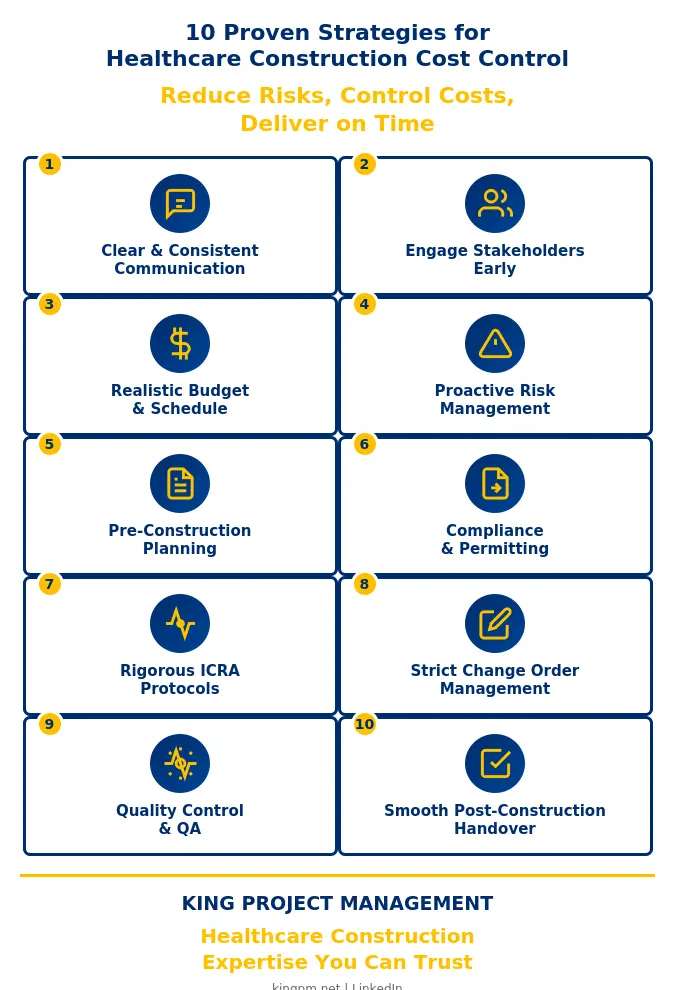
6. Compliance and Permitting
Healthcare facilities face more regulatory oversight than perhaps any other building type. Compliance issues discovered late can derail budgets and schedules.
Real-World Example: A medical office building renovation proceeded to construction without completing a proper life safety analysis. During the building department review, inspectors identified that the renovation triggered requirements for a complete fire sprinkler system upgrade throughout the building—not just the renovation area. This $280,000 surprise wasn’t budgeted, causing a 12-week delay while the sprinkler design was completed and materials were ordered.
What You Can Do
- Engage Regulatory Experts Early: Bring in specialized healthcare regulatory consultants during design to ensure compliance with FGI Guidelines, NFPA codes, CMS requirements, Joint Commission standards, and state-specific healthcare regulations.
- Create a Permitting Roadmap: Develop a detailed permitting timeline showing each permit required, submission deadlines, estimated review periods, and approval dates. Track actual progress against this roadmap.
- Pre-Submittal Meetings: Request pre-submittal meetings with the building department and fire marshal before formal permit applications. These meetings can identify issues early and establish rapport with reviewers.
- Submit Complete Permit Applications: Incomplete applications cause delays. Use checklists to ensure every required document, calculation, detail, and specification is included in your submission.
- Plan for Inspection Scheduling: Understand the building department’s inspection scheduling lead times and build these into your construction schedule. In some jurisdictions, inspections require 48-72 hours notice and can take several days to complete.
7. Rigorous Infection Control Risk Assessment (ICRA)
ICRA compliance isn’t just a regulatory checkbox—it’s a critical cost control mechanism. ICRA violations can halt construction, require costly remediation, and even lead to patient-harm incidents that create significant liability.
Real-World Example: During an ER expansion project, the contractor failed to properly maintain negative pressure in the construction zone. Dust migrated into adjacent patient care areas, triggering an infection control emergency. The hospital shut down construction for 72 hours while the entire affected area underwent deep cleaning and air quality testing. The incident cost $95,000 in direct expenses, damaged the hospital’s relationship with the contractor, and delayed the project by two weeks. Proper ICRA protocols would have prevented this entirely.
What You Can Do
- Conduct Thorough ICRA Planning: Before construction begins, complete a formal ICRA matrix that classifies construction activities by risk level (Class I-IV) and patient population risk (low, medium, high, highest). This determines the required infection control measures.
- Install Proper Barriers and Containment: Use appropriate barriers for the ICRA class: Class III and IV work requires rigid barriers sealed at ceiling, floor, and walls with separate HEPA-filtered negative pressure and anteroom access. Don’t cut corners—improper barriers lead to shutdowns.
- Implement Continuous Air Quality Monitoring: Deploy particle counters in adjacent occupied areas to verify barrier effectiveness. Set alert thresholds and establish protocols for immediate response if contamination is detected.
- Maintain Daily ICRA Logs: Document daily barrier inspections, pressure differential readings, and any breaches or corrective actions. This documentation proves compliance and provides a defense against infection control allegations.
- Coordinate with Infection Preventionists: Establish regular communication with the hospital’s infection prevention team. They should inspect barriers before work begins and periodically during construction. Their buy-in prevents costly work stoppages.
- Plan for Emergency ICRA Response: Develop protocols for barrier failures, accidental breaches, or urgent clinical access needs. Having pre-approved procedures saves time and money when issues arise.
8. Strict Change Order Management
Change orders are the single most significant cause of cost overruns in healthcare construction. A project with poor change-order management can easily experience 15-20% cost growth, while disciplined management typically limits growth to 3-5%.
What You Can Do
- Create a Formal Change Order Process: Document who can authorize changes at different dollar thresholds. For example: $0-$5,000 = project manager, $5,000-$25,000 = owner’s representative, $25,000+ = owner approval with board review for amounts over $100,000.
- Distinguish Change Categories: Classify each change as owner-initiated, design error, unforeseen condition, or contractor error. Owner-initiated changes are negotiable; design errors may be the architect’s responsibility; contractor errors should have no cost impact to the owner.
- Require Full Impact Analysis: Every change order must include: detailed scope description, cost breakdown, schedule impact, effect on other trades, and impact on commissioning/training requirements. Never approve changes without understanding the total implications.
- Bundle Related Changes: When possible, group multiple small changes into a single package. This improves negotiating leverage and reduces administrative overhead. Issue change orders monthly rather than individually.
- Maintain a Change Order Log: Track every proposed change from initial request through approval or rejection. Include: date requested, description, estimated cost, actual negotiated cost, approval status, and reason for owner-initiated changes. Review this log monthly with stakeholders.
- Establish “No Change Order” Periods: Define blackout periods (typically final 6-8 weeks before occupancy) where no change orders will be considered except for life safety or critical operational issues. This prevents last-minute scope creep.
- Document Everything: Photograph existing conditions that may trigger claims for differing site conditions. Maintain detailed records of all communication about potential changes. This documentation is crucial for dispute resolution.
9. Comprehensive Quality Control
Defects and rework typically account for 5-10% of total project costs. Robust quality control catches issues early when they’re inexpensive to fix, rather than after finishes are installed or systems are commissioned.
Real-World Example: A new surgical suite project installed the OR’s medical gas outlets before the third-party testing agency verified proper labeling and connections. During commissioning, testing revealed that oxygen and medical air were cross-connected in two rooms—a potentially fatal error. Correcting the problem required demolition of finished walls, re-piping, re-inspection, and re-finishing. The rework delayed occupancy by three weeks. A simple pre-installation inspection and test would have caught this error for less than $500.
What You Can Do
- Establish Quality Standards Early: Define acceptable quality standards for critical work during pre-construction. Create mock-ups for complex assemblies (curtain wall, casework, ceiling systems) and use these as the quality benchmark throughout construction.
- Implement Inspection Protocols: Develop checklists for critical installations: underground utilities before backfill, structural steel connections before fireproofing, above-ceiling rough-ins before drywall, and waterproofing before covering. Once covered, these are expensive to access.
- Require Third-Party Testing: For critical systems (medical gas, fire alarm, emergency power, HVAC controls), engage independent testing agencies. Don’t rely solely on contractor self-certification. The cost of third-party testing is negligible compared to the risk of system failures.
- Conduct Regular Quality Walks: Weekly quality walks with the owner’s team, architect, and contractor identify issues in real-time. Use a standardized punch list format and assign responsibility with deadlines for correction.
- Verify Material Certifications: Ensure all materials meet specified standards and that proper certifications are provided. This is especially critical for fire-rated assemblies, medical equipment, and infection control materials.
- Document Quality Issues: Photograph defects, non-conforming work, and corrections. This documentation supports payment withholding if necessary and provides evidence for warranty claims.
- Hold Trade Contractors Accountable: Include quality requirements in subcontract agreements with clear consequences for defective work. Back-charge for work that others must correct.
10. Smooth Post-Construction Handover
The transition from construction to operations is where many projects stumble. A rough handover can negate the value of an otherwise successful project.
What You Can Do
- Start Commissioning Early: Begin commissioning during equipment installation, not after substantial completion. This identifies problems when contractors are still mobilized and motivated to fix them.
- Create Comprehensive O&M Manuals: Ensure operation and maintenance manuals are complete, organized, and actually helpful to facilities staff. Include equipment specifications, warranty information, preventive maintenance schedules, parts lists, and vendor contacts.
- Conduct Extensive Staff Training: Schedule training sessions for all equipment and systems before occupancy. Conduct hands-on training with the actual staff who will use the equipment, not just department managers.
- Develop Operational Readiness Plans: Create detailed plans for the transition from construction to operations, including equipment testing schedules, move-in logistics, supply stocking, IT system activation, and emergency procedure verification.
- Perform Mock Scenarios: Before opening patient care areas, conduct mock code drills, patient admission scenarios, and emergency procedures to identify operational issues while there’s still time to address them.
- Schedule Post-Occupancy Reviews: Plan for 30-day, 90-day, and one-year post-occupancy reviews to assess building performance, identify any warranty issues, and capture lessons learned for future projects.
- Establish Clear Warranty Procedures: Create a system for reporting and tracking warranty items. Assign someone to manage warranty follow-up and ensure issues are resolved before each warranty expires.
Key Cost Control Takeaways
Planning Phase:
- Engage all stakeholders (clinical, facilities, infection control, regulatory) from project inception
- Invest in comprehensive site due diligence and regulatory research before finalizing design
- Create realistic budgets with appropriate contingencies (12-15% for renovations, 8-10% for new construction)
- Develop detailed risk registers and update them monthly throughout the project
Design Phase:
- Consider design-build or CM-at-Risk delivery methods to bring construction expertise into design
- Conduct constructability reviews at 60% and 90% design completion
- Use BIM for clash detection and coordinate all disciplines before construction
- Establish clear design freeze dates with formal change order processes for later modifications
- Include infection control planning in design to define proper ICRA classifications
Permitting & Regulatory:
- Engage healthcare regulatory experts during design, not during construction
- Hold pre-submittal meetings with building departments and fire marshals
- Create detailed permitting roadmaps and track progress against them
- Submit complete permit applications the first time to avoid delays
Construction Phase:
- Maintain clear communication protocols with defined response timeframes
- Implement rigorous ICRA protocols with proper barriers, monitoring, and documentation
- Establish formal change order management with clear approval thresholds and impact analysis
- Conduct weekly quality walks and implement inspection protocols for critical work
- Update risk registers monthly and address high-priority risks proactively
Closeout Phase:
- Begin commissioning during installation, not after substantial completion
- Provide comprehensive training to all staff who will use the new systems and equipment
- Conduct mock scenarios in patient care areas before opening
- Schedule post-occupancy reviews at 30 days, 90 days, and one year
- Establish clear warranty tracking and management procedures
Critical Success Factors:
- Change orders cause more overruns than any other factor—control them ruthlessly
- ICRA violations can halt projects and create liability—invest in proper infection control
- Quality issues discovered late cost 10x more to fix—inspect early and often
- Healthcare construction requires specialized expertise—don’t rely on commercial construction teams alone
- Front-load effort in planning and design; money spent early prevents costlier problems during construction
Let's Build Your Project the Right Way
Controlling costs and reducing risks in healthcare construction requires experience, attention to detail, and proactive project management. Whether you’re planning a new facility, expanding existing space, or managing complex renovations within operating environments, the strategies outlined here can help you deliver successful projects.
At King Project Management, we specialize in healthcare construction projects where precision matters. Our expertise in ICRA protocols, regulatory compliance, and stakeholder coordination ensures your project is delivered on time and within budget, with minimal disruption to your operations.
Ready to discuss your healthcare construction project? Let’s talk about how we can help you meet tight deadlines, maintain budget discipline, and navigate the unique challenges of healthcare construction. Connect with me through kingpm.net or on LinkedIn, and let’s get your project done right.